PROFESSIONAL EDUCATION + REALISTIC PAPER EXECUTIONLearn the craft.
Paper onlyStrictly simulated execution 89 instrumentsAccount-fed forex and metals catalogue Professional ordersEntry, protection and lifecycle controls Audit readySignals, fills, costs and outcomes retained
Learn the craft.
Build the system. Prove the process.
Signal Veritas unites a structured trading academy, professional chart workspace, visual strategy laboratory and capability-driven paper brokerage. Learn on current market context, design rules, simulate realistic orders and preserve the evidence behind every decision—without placing a live trade.
Two connected products
Build knowledge, then practise it where decisions happen.
The Trainer teaches concepts progressively. The Trader turns those concepts into observable chart work, professional strategy specifications, capability-aware paper orders and auditable evidence.
Signal Veritas Trainer
A structured Academy from market foundations to advanced technical analysis, strategy design, validation and paper-trading practice.
- Database-backed lessons and assessments
- Live visual demonstrations and narration
- Exercises, progress, scores and badges
- English and Hinglish learning paths
Signal Veritas Trader
A professional paper environment for chart study, custom strategy engineering, capability-driven order simulation and evidence-led review.
- Executable bid/ask market watch and interactive charting
- Indicators, overlays, measurements and drawing families
- User-created, versioned strategies by instrument
- Paper orders, lifecycle evidence, journal and feedback
The Trainer
Trading education that reaches beyond definitions.
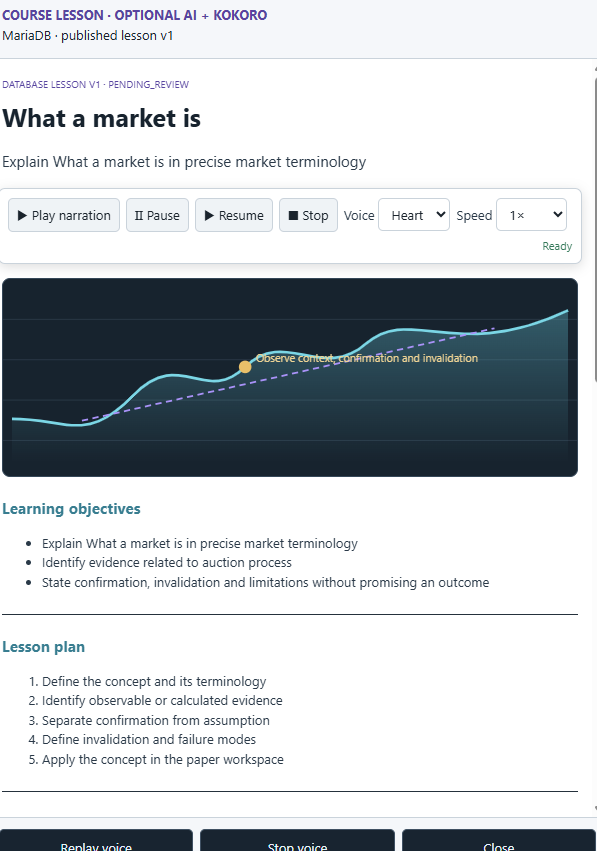
Every lesson connects theory to the interface. The AI coach can highlight controls, candles, indicators, overlays and chart evidence while narration explains what the learner should observe.
- Basics-to-professional curriculum roadmap
- Prerequisites, module difficulty and mastery badges
- Visual reading guides with live UI walkthroughs
- Knowledge checks with immediate explanations
- Assessed exercises based only on taught material
The Trader
A terminal for disciplined hypotheses—not promises.
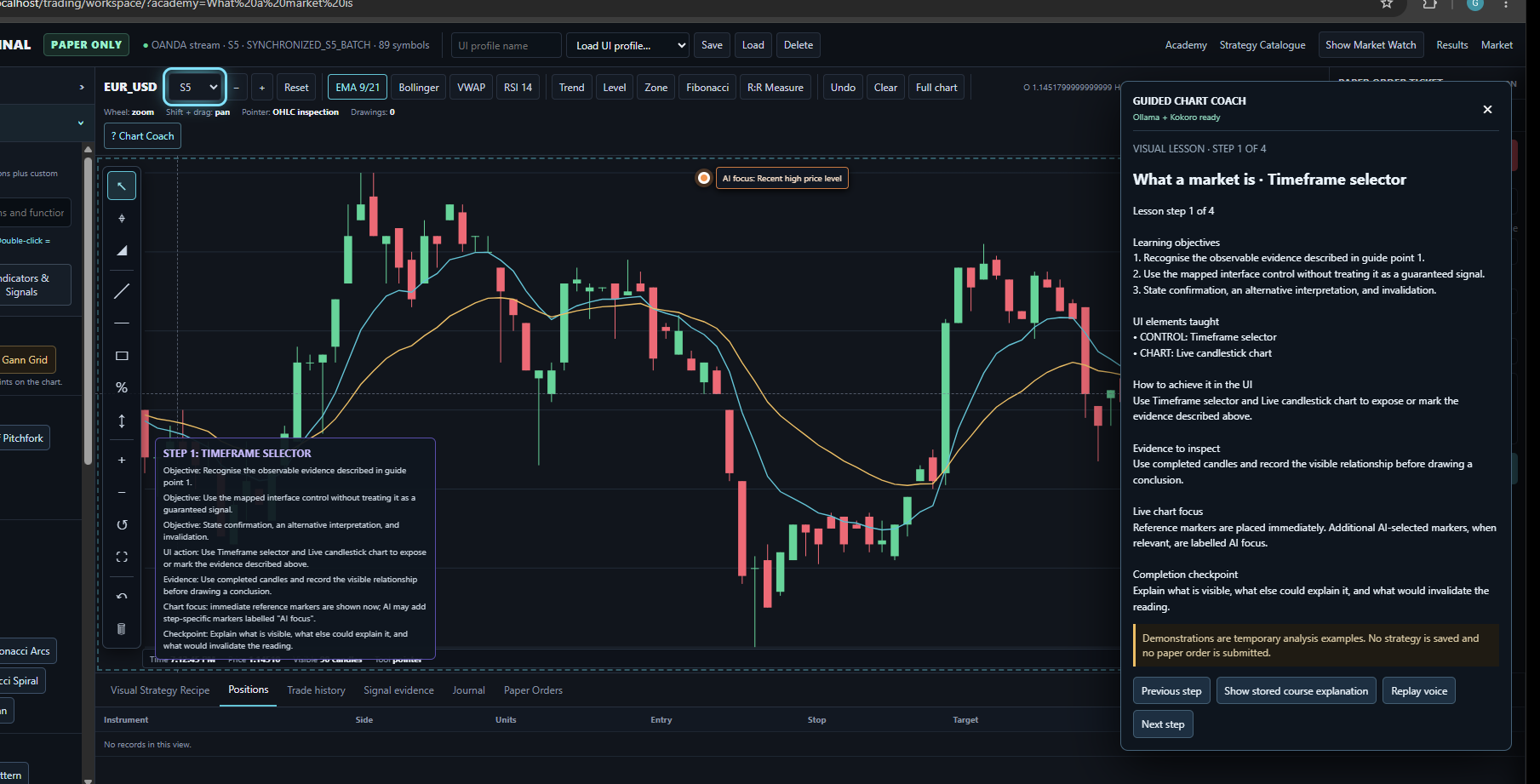
Study live-fed charts, configure a professional workspace, build symbol-specific rules, attach capability-aware paper orders and inspect the evidence behind every simulated outcome.
- Technical-analysis overlays, indicators and drawing families
- Market watch with live bid, ask, spread and timeframe context
- AI analysis, Chart Coach and universal UI Helper
- Visual Strategy Composer and saved, versioned user strategies
- Positions, trade history, signal evidence, journal and paper orders
- Formal strategy feedback with trackable parameter revisions
Capability-driven paper brokerage
Professional order controls. Realistic lifecycle evidence.
The terminal distinguishes platform support, user intent, administrator permission and instrument-level constraints before a simulated order can be accepted.
MarketLimitStopMarket if touchedTake profitStop lossTrailing stopGuaranteed stop capabilityGTCGTDDAYFOKIOC
Instrument constraints
Minimum and maximum size, unit increments, precision, pip location, margin, stop distance, shorting and fractional-unit eligibility.
Executable pricing
Buy orders reference the ask, sells reference the bid, with spread and slippage retained at the simulated fill.
Order lifecycle
Submitted, pending, triggered, filled, closed, cancelled, rejected and expired states remain traceable through immutable events.
Cost-aware results
Gross result, commissions, financing, conversion assumptions and net paper P&L are designed as separate auditable components.
89Current instrument constraints
623Instrument and order mappings
Paper onlyNo live broker execution
Professional strategy engineering
From visual hypothesis to a versioned, executable paper specification.
Strategies are more than indicator combinations. Define where a method applies, what confirms it, what invalidates it, how an order is created and how every outcome will be reviewed.
Design and qualification
- Markets, symbols, timeframes, sessions and weekdays
- Context, regime, candidate scanner and event relationship
- Setup, confirmation, invalidation and entry rules
- Required data, provenance and readiness checks
- One-to-many conditions without comma-separated shortcuts
Execution and governance
- Associated order type and entry-price rule
- Risk-percent or fixed-unit position sizing
- Spread, slippage, stop, target and expiry controls
- Maximum positions, trade frequency and account quotas
- Strategy versions, evidence, journal and formal feedback
Your terminal should reflect how you intend to trade.
During signup, select intended markets and order capabilities. Account permissions and instrument rules then determine what can be configured and paper tested.
Account governance and personalisation
A serious workspace needs controls beyond the chart.
One governed account connects Academy learning and Trader paper activity.
Administrators can enable products, modules, markets and order capabilities per user.
Assigned document versions and acceptance status remain attached to each user.
Login events, device fingerprints, IP and location context support account review.
Trade frequency, parallel sessions, running strategies and saved-strategy quotas are controllable.
Save chart, marker, filter and interface preferences instead of rebuilding the terminal every visit.
A complete learning environment
Not another signal service.
Signal Veritas is designed to make the learner explain, test and document decisions instead of blindly following alerts.
Relevant candles, markers, controls and chart sections heartbeat while the lesson explains them.
Create and store strategies by market, symbol, timeframe, session and rule set.
Paper orders model entry type, sizing, spread, stops, targets and outcome evidence.
Prerequisites and module scoring guide learners from foundations to professional practice.
Review signals, conditions, orders, fills, exits and profit or loss without hindsight shortcuts.
AI demonstrates and explains; it does not place live trades or promise profitable outcomes.
The Signal Veritas loop
Learn. Observe. Practise. Validate.
Study the concept
Read authored lessons, objectives, examples, failure modes and knowledge checks.
Watch it live
Open a guided chart demonstration using current paper-market context and highlighted evidence.
Do the chart work
Apply the relevant tools, annotate evidence and submit lesson-bound exercises.
Track the result
Run custom rules in the paper environment and review performance with full lineage.
Learn and test without live execution.
Signal Veritas is an educational and paper-trading environment. Technical analysis expresses hypotheses, not guaranteed outcomes. No live broker order is submitted from these systems.
Turn trading curiosity into a documented practice.
Start with the Academy, then take what you learn into the paper workspace. Build evidence before confidence.
Evidence-based gamification
Progress by proving skill—not by chasing points.
The Learning Arena turns the curriculum into missions, competency ratings, streaks, mastery badges and discipline-weighted paper seasons. A correct no-trade decision earns recognition because restraint is part of trading competence.
10progression ranks
12competencies
16specialist badges
8mission formats
3scored attempts
5%maximum raw P/L weight
Market Observer
Learn evidence, context and uncertainty.
Chart Reader
Interpret completed candles and structure.
Strategy Designer
Build explicit, versioned hypotheses.
Risk Controller
Put defined loss before possible reward.
Strategy Auditor
Review decisions without hindsight.
Veritas Master
Demonstrate repeatable professional practice.
Immersive curriculum upgrade
Every lesson now teaches through candles—not vague outlines.
All 288 stored lessons combine substantive authored material with live visual stages, candle-by-candle formation examples, invalidation cases, timeframe ambiguity, narration, overlays and assessed practice.
Completed-candle anatomy
Read open, high, low, close, body, range, wick relationships, close location and relative volume before interpreting a formation.
Explore immersive lessonsConfirming versus failed formations
Compare a sequence that accumulates evidence with a similar-looking sequence that breaks its confirmation or reaches invalidation.
Watch a live demonstrationLive chart workshops
Pause the feed, heartbeat the relevant control or candle, attach markers to price and time, then complete coach-verified actions.
Start a chart missionDo not merely read about a concept. Find it, mark it and explain it.
Open an authored lesson, replay it on the paper chart, then submit work that tests only what the lesson taught.
Strategy intelligence
Explore 220 strategies, then turn observation into an auditable paper system.
Browse eleven strategy families, open a live chart demonstration, detect forming candidates from executable rules, configure required risk parameters and preserve every strategy revision.
Strategy Encyclopedia
Study market hypothesis, regime, setup, confirmation, invalidation, order logic, risk, evidence, parameters and limitations.
Browse all strategiesAuto-match forming candidates
Versioned detectors examine live context. Names and descriptions never trigger a match; required history, thresholds and data dependencies do.
Open Strategy IntelligenceCapture what you see
Select a candle formation, preserve markers and UI state, convert it into explicit conditions, and continuously paper-track later occurrences.
Build a strategyAlready have a hypothesis?
Take it into the visual Strategy Composer, define the missing rules, attach a paper order and keep the evidence.
Replay, review and improve
A paper trade should remain understandable long after it closes.
The Trader stores chart state, drawings, indicator settings, strategy version, signal evidence, executable price, costs, order lifecycle and outcome. Trade Review reconstructs the decision window while AI Analysis Demo Replay walks through the evidence.
Chart time machine
Return to the relevant symbol and timeframe with entry, stop, target, exit, risk and reward overlays anchored to historical candles.
Market description on demand
Ask for the current market type and receive evidence using structure, volatility, momentum, liquidity, spread and timeframe context.
Versioned feedback
Review losses, propose trackable parameter changes, state expected impact and test whether later evidence supports the correction.